
US FMC Bonds Knowledge
Manifest Filing Knowledge Company News Industry Updates Bonds FAQ US FMC Bonds Knowledge Insurance Knowledge
-
 Release time:09.11.2026Many logistics groups operate across several overseas markets but serve the same U.S. ocean trade customers. This guide helps multi-country NVOCC teams decide whether to manage FMC compliance through a centralized service plan, separate local office review, or a hybrid model covering legal entity, bond, tariff, HBL, SCAC, AMS, and public verification.
 -
 Release time:09.11.2026Foreign-based registered NVOCCs should not treat FMC registration renewal as a simple calendar reminder. Before renewal, overseas freight forwarders should review whether company information, trade names, bond records, Form FMC-1, tariff setup, legal agent details, and U.S. route operations are still accurate. This guide helps foreign NVOCCs decide whether they need renewal support, update support, or a full compliance re-assessment.
 -
 Release time:09.10.2026Freight forwarders and NVOCCs in Asia, the Middle East, and South Asia often need FMC qualification when expanding into U.S. ocean trade. This guide explains what Vietnam, Hong Kong, South Korea, India, Japan, Singapore, Thailand, Malaysia, Indonesia, UAE, Pakistan, Sri Lanka, Bangladesh, and other overseas companies should review before choosing an FMC service plan.
 -
 Release time:09.10.2026Foreign NVOCCs do not always need to visit the United States to start FMC qualification preparation. This guide explains how overseas freight forwarders can use remote service support for route diagnosis, company information review, FMC registration or license planning, NVOCC bond handling, tariff setup, and U.S. route compliance preparation.
 -
 Release time:09.09.2026When an FMC penalty issue, inquiry, or compliance notice appears, an NVOCC should respond with organized records and a clear corrective action plan. This guide explains what documents to prepare, what issues to review, and when professional support or legal counsel may be needed.
 -
 Release time:09.09.2026Foreign NVOCCs entering U.S. ocean trade should not treat FMC qualification as a simple certificate. Missing registration, inactive bond records, tariff issues, outdated company information, or unclear HBL identity may create penalty exposure and business disruption. This guide explains how to review penalty risk before operations begin.
 -
 Release time:08.21.2026AMS filing accuracy depends on the quality of shipment data before submission. This guide helps foreign NVOCCs decide whether to include AMS data validation, pre-filing review, cargo description checks, HBL consistency review, and correction support in their U.S. route service scope.
 -
 Release time:08.21.2026Foreign NVOCCs choosing an AMS filing workflow should not only compare filing prices. They should decide whether online entry, Excel batch import, or API integration best fits their shipment volume, staff capability, data structure, customer needs, and long-term U.S. route strategy.
 -
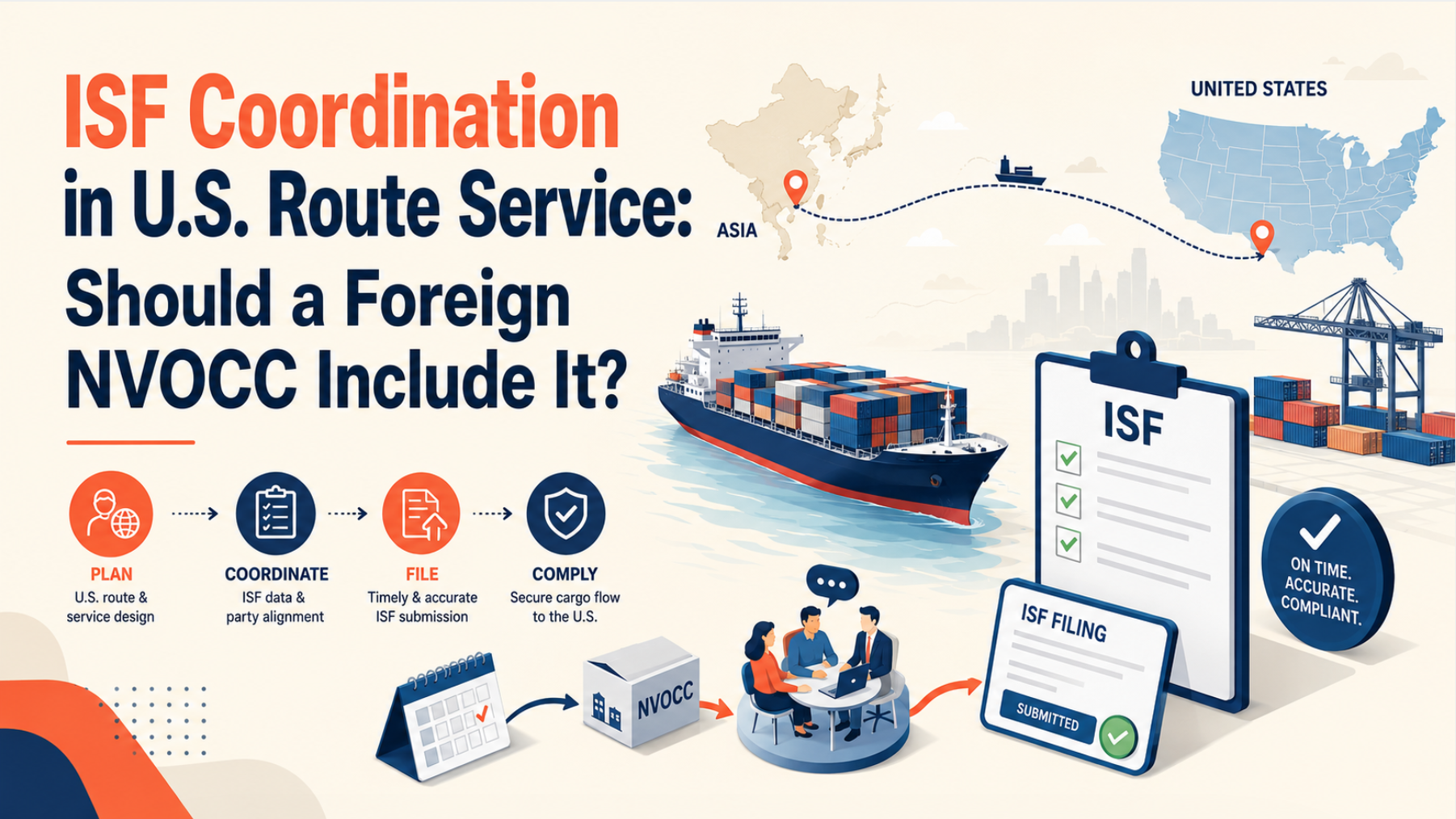 Release time:08.20.2026ISF is not the same as AMS or FMC qualification, but foreign NVOCCs serving U.S. routes often need to coordinate shipment data with importers, customs brokers, and filing providers. This guide helps NVOCCs decide whether ISF coordination should be included in their U.S. route service scope.
 -
 Release time:08.20.2026A foreign NVOCC that wants direct AMS filing capability may need more than FMC qualification and SCAC. This guide explains when an International Carrier Bond should be reviewed, when third-party filing may be enough, and how NVOCCs should decide whether to include this step in their U.S. route service scope.